
Identifying individual adders by photograph
A working reference on the science behind recognising individual Vipera berus from their head-scale patterns — the methods, the evidence they work, the software, and what it means for our catalogue.
The method was pioneered in Britain by Sylvia Sheldon and Christopher Bradley in the Wyre Forest. Their 1989 paper showed that no two adders share the same head markings and set out a simple field procedure to code and re-identify individuals — markings that held steady across the study.[13] That hands-on approach, still applied in the Wyre Forest decades later,[14] is the direct ancestor of everything below, and the closest model for a small, patiently-watched population like ours.
Why this matters
Every adder wears its own fingerprint
Adders can be told apart individually because the mosaic of shields on the crown of the head — their number, shape, fusions and splits — varies enough between snakes to be unique, yet stays fixed for life. That single fact turns a camera into a non-invasive marking tool: no toe-clipping, no tags, no handling stress, and a method open to volunteers. For a small, closely-watched population it is close to ideal, because a handful of animals can be followed year on year to reveal survival, longevity, site fidelity and breeding.[1]
The cornerstone study
Bauwens, Claus & Mergeay (2018): genetics proves the camera right
Sheldon & Bradley showed the field method worked; three decades later a Belgian team supplied the definitive proof, running photographic ID and DNA fingerprinting side by side on the same population to ask whether they agreed. They did — completely.[1] A 2024 follow-up extends the same catalogue further still.[16]
How they did it
A compact camera captured the dorsal (top-down) view of the head. Identity rested on the counts, shapes and arrangement of predefined scale groups — apicals, canthals, intercanthals, parafrontals, the frontal, parietals and interparietals. A short multi-character code narrowed the candidates, after which two observers confirmed the match by eye.[1]
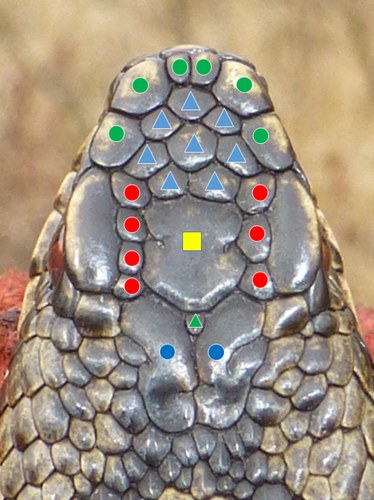
The method works precisely because vipers have richly variable head scalation. It does not transfer to most colubrids (grass snakes), whose head shields are too uniform.[1]
Field & matching technique
From a snake in the grass to a catalogue entry
Across studies the workflow is consistent: get a clean top-down head shot, describe the scale groups, then match the new photo against the catalogue — by eye, by code, or by software.
- Dorsal, straight-on, filling the frame with the crown of the head; even, diffuse light avoids shadows that hide shield borders. Consistency between shots is the single biggest driver of match reliability.[6]
- Snakes can be photographed in the hand or in situ while basking — non-invasive either way, a welfare and cost advantage over toe-clipping or tags.[9]
- The apical, intercanthal and parafrontal scales carry the most individual signal, and identity is independent of sex and age.[6]
| Step | What happens | Practical note |
|---|---|---|
| 1 · Capture | Top-down head photo + date, location, sex | Same framing every time; GPS if possible |
| 2 · Describe | Count / shape of scale groups, or extract keypoints | Apicals, intercanthals, parafrontals do the work |
| 3 · Shortlist | Code or software ranks likely matches | Cuts hundreds of comparisons to a handful |
| 4 · Confirm | Human checks the top candidates by eye | Two independent observers in Bauwens et al. |
| 5 · Log | New individual, or a re-sighting of a known one | Re-sightings build the life history |
Automation
Software that does the shortlisting
Manual matching becomes error-prone as a catalogue grows, so most studies use pattern-matching software to rank candidates before a human confirms.[9] None fully replace the eye — they shorten the search.
| Tool | Approach | Use in vipers / reptiles |
|---|---|---|
| I3S | User marks reference points; ranks matches | Semi-automatic route in V. berus [6]; ~94–95% re-ID in lizards [9] |
| APHIS | Feature/point photo-matching | Reliable and fast for V. berus head scales [5][10] |
| HotSpotter | Local-feature retrieval, no manual points | Identified 27 of 28 recaptured V. ammodytes [4] |
| Wild-ID | SIFT keypoint matching | Strong general CMR performer [9] |
| Deep learning | Learned features, automatic re-ID | Emerging; high accuracy given training images [9] |
Adder ID's own matcher uses SIFT keypoints with geometric verification — the same family as Wild-ID and HotSpotter. That places it squarely in the accepted space as a shortlister, with the final call left to the eye, exactly as the literature recommends. As the catalogue grows, I3S or HotSpotter are proven options worth benchmarking against.
Beyond the adder
The technique generalises — with limits
Head-scale photo-ID has been genetically validated in the prairie lizard too,[3] and in the nose-horned viper frontal head shots let HotSpotter recover nearly every recapture across a five-year study.[4] Reviews stress the trade-offs: natural-mark methods are cheap, low-stress and volunteer-friendly, but manual matching scales badly and small-bodied taxa are hard to photograph consistently.[9]
Head shields are not perfectly immutable — rare anomalies and injuries can alter them (0.3% of animals in Bauwens et al.), and head-scale instability is documented in the northern viper.[8] In practice: note scars and unusual shields on a profile, and treat a single ambiguous re-sight with caution.
Life history
The adder's year: an annual cycle keyed to temperature
The adder is a cold-adapted, capital-breeding, viviparous viper whose whole year turns on thermoregulation. Its calendar is what makes a life-events log scientifically meaningful — each event (sloughing, mating, gravidity, birth) falls in a predictable window, so a well-dated history reveals an individual's phenology, and departures from the expected timing are themselves data.
Winter — hibernation (Sep/Oct–Feb)
The active year closes as adders return to their hibernacula and enter dormancy from about September or October.[25] Hibernacula are frost-free underground cavities — old small-mammal burrows, root channels, rock crevices, banks and screes — below the frost line but above the water table. The same refuges are reused for many years with strong fidelity, and a single good site can shelter many snakes: aggregations of up to around a hundred adders have been reported.[7][25] This is really brumation rather than deep hibernation — metabolism collapses, but animals may stir and bask at the entrance on mild days.
Adders are among the most cold-tolerant snakes on Earth, which is how the species ranges further north than any other reptile — beyond the Arctic Circle in Scandinavia, where hibernation can last seven to eight months.[23][24] Winter is nonetheless a major bottleneck: cold, flooding or predation in the den is a significant source of annual mortality, falling hardest on lean juveniles and spent, post-partum females.
Spring — emergence & the nuptial slough (late Feb–Apr)
Emergence is temperature-gated. Adult males appear first, from late February into March — a protandry driven by their greater cold-tolerance — and its timing can be predicted mechanistically: microclimate models show spring emergence tracks accumulated degree-hours and absolute-temperature thresholds at the den.[17] Fresh-out males stay tight to the hibernaculum for roughly a month, basking hard to raise body temperature and complete spermatogenesis while fasting.[7] Because emergence is microclimate-driven and has been advancing with warming springs, there is concern adders could fall into a phenological “climate trap,” emerging before conditions reliably support them.[17] Within days to weeks a male sheds his winter skin in a nuptial slough that leaves him in bright breeding colours; adult males slough about three times a year, females only once or twice.[17] Females emerge one to three weeks after the males.
The mating system — combat, searching & polyandry (Apr–May)
Mating is explosive and brief, concentrated over a few weeks in April–May near the hibernacula. Rival males perform the ritualised “dance of the adders” — two males rear up and wrestle, each trying to force the other down, without biting — then range widely to track females by scent.[7] Body size decides much of the outcome: mating success climbs steeply with male length, and the largest males tend to monopolise whole litters.[27][28] Yet the system is far from closed — multiple paternity is common, reaching roughly 69% of litters even in sparse, low-density populations.[28] Females appear to benefit from this polyandry: those mating with several males produce fewer stillborn young, a sperm-competition or genetic-quality advantage that helps explain why females mate multiply.[28] This foundational sexual-selection work on Scandinavian adders is associated above all with Madsen, Shine and Olsson.
Summer — gestation & maternal thermoregulation (May–Aug)
Now the sexes' ecologies diverge sharply. Adders are viviparous — eggs are retained and the young born live — so a gravid female must incubate the litter with her own body heat, and becomes a dedicated basking machine. Gravid females thermoregulate at higher and far more precise body temperatures than non-breeding females, holding station at specific sunny microsites (one comparative study recorded adders basking over ground temperatures around 23–24 °C) and lying out even in poor weather to keep embryos near their developmental optimum.[19][26] That precision carries a cost in exposure: basking gravid females are conspicuous and easily encountered, which biases sightings toward them.[19]
Reproduction is expensive in the extreme. Adders are capital breeders, fuelling the litter from stored reserves rather than summer feeding, so a breeding female largely stops feeding, stops growing, and can lose about a third of her body mass by parturition. The bill is paid in frequency: females breed only every two — sometimes three — years, and only if body condition at spring emergence exceeds a threshold.[18] Meanwhile males and non-breeding females migrate out to distinct summer foraging grounds, giving males much larger home ranges (of order 5 ha) than sedentary gravid females (well under 1 ha).[7][20][21]
Late summer — birth & the first weeks (Aug–Sep)
After a gestation of roughly 4½ months the young are born live, typically in the second half of August or early September and usually back near the hibernation area.[18] Litters run from about 3 to 20 (often ~5–15), each neonate around 14–20 cm long and enclosed in a thin membrane it ruptures almost at once. The young stay near the female for only a few days, take their own first slough within about a week, and then disperse to feed and — before winter — to find a hibernaculum.[25] Neonates may travel surprisingly far to select a first winter refuge; some emergent juveniles then fail to home back to it the following spring and must find a new den, an early and heavy filter on survival.[22] Spent females feed hard through the rest of the season to rebuild the reserves they will need before they can breed again.
Autumn — the return migration (Sep–Oct)
As days shorten and nights cool, adders reverse their spring journey, migrating from the summer feeding range back to the traditional hibernaculum before settling in for winter.[20][22] Late-season basking continues opportunistically — this is the last window to feed and lay down reserves before dormancy.
Growth, maturity & longevity
Adders grow fastest as juveniles and slow sharply after maturity, which comes late for such a small snake: a minority of females first breed at three years, but most not until four or older, and males mature at around three to four.[18][25] Growth then decelerates towards an asymptotic snout–vent length of very roughly 63 cm in males and 68 cm in females in one von Bertalanffy analysis, with year-to-year weather strongly modulating juvenile growth.[18][29] Wild adders commonly live ten to fifteen years, and captives have reached about thirty.[25] Combined with biennial female breeding, this slow, long life means populations turn over slowly and recover from losses only gradually — a key vulnerability for small colonies.
Colour, sexual dimorphism & melanism
The sexes are usually separable on sight, most sharply around the spring mating season: males tend to be grey, silvery or cream with a crisp black dorsal zigzag, while females are browner or reddish with a darker-brown zigzag. Body length differs little between the sexes, but males have relatively longer tails and larger, higher heads.[25][30] All-black (melanistic) adders occur in many populations, more often at higher latitudes and altitudes; the classic explanation is thermal — dark animals warm faster in cool climates — though whether melanism is consistently adaptive is debated, and it may carry costs such as greater conspicuousness to predators.[30] Melanistic and normally-coloured adders can even differ subtly in venom composition.[31]
Feeding & venom
Adders are ambush-and-search predators of small vertebrates — chiefly voles, shrews and mice, together with common lizards, slow-worms, amphibians and nestling birds; juveniles begin on smaller fare such as young lizards and invertebrates.[25] A hunting adder typically strikes, injects venom and releases the prey, then follows the scent trail to the dying animal and swallows it whole. The venom is primarily a feeding adaptation — subduing and beginning to digest prey — with a secondary defensive role.[31] It is medically significant but rarely fatal to people (murine LD50 ≈ 0.55 mg/kg); bites cause local pain, swelling and occasionally spreading haemorrhage.[25] Because breeding males and gravid females fast, most feeding — and hence most growth and reserve-building — is compressed into summer, in the feeding range away from the den.
Predators, mortality & threats
Adders are taken by birds of prey and owls, corvids and herons, and by mammals such as foxes, badgers, mustelids and hedgehogs, as well as being killed on roads and deliberately by people. Mortality is strongly seasonal and stage-structured — overwinter losses in the den, and the exposure gravid females accept while basking, both take a toll — so detectability, body condition and death rates all swing through the year.[19] At the population scale the species is in steep, well-documented decline across much of Britain, driven by habitat loss and fragmentation, disturbance, unsympathetic management and small-population genetic erosion.[2][11]
Spatial & temporal patterns to expect locally
- Two centres of gravity. A hibernaculum / emergence-and-mating area, and a separate summer feeding range, linked by seasonal migration — with high fidelity to the hibernaculum.[7][20][22]
- Sex- and stage-specific detectability. Males are most visible at emergence and mating; gravid females through summer basking. Encounter rates are biased toward whoever is lying out.[19]
- Site-faithful individuals. The same animal reappears at the same spots across weeks and years — exactly what a photo-ID catalogue captures.[20]
The app's life-event types map straight onto this calendar — sloughed (spring), mated (Apr–May), gravid (May–Aug), gave birth (Aug–Sep). Recording them with dates lets the timeline reveal each adder's personal phenology and flag the unusual: an unusually early emergence, or a female that breeds two years running.
Population context
How adders are surveyed at scale
- Make the Adder Count — the UK scheme (since 2005, 260+ sites) uses standardised counts of adders basking after spring emergence, and found small populations declining while a few large sites hold — evidence adders face local extinction across much of Britain.[2]
- Classic ecology — Prestt's southern-Britain study frames adder movement, home range and site fidelity.[7]
- Genetic vulnerability — small isolated British populations show genetic erosion, sharpening the case for close monitoring.[11]
What limits national counts is a strength here: with only a handful of animals, a photo-ID catalogue can follow named individuals across years — survival, longevity, site fidelity, and reproduction (via gravid females and birth events) that counts alone never see.
So what
Recommendations for our study
- Standardise the head shot — dorsal, straight-on, head filling the frame, even light. Consistency is the biggest lever on reliability. [1][6]
- Capture the metadata that unlocks demography — date, GPS, sex, and life events (born, mated, gravid, gave birth, died); these turn re-sightings into survival and breeding histories. [1]
- Keep the eye in the loop — use the matcher to shortlist, confirm by eye, ideally a second observer for new matches. [1][4][9]
- Note scars and odd shields — ~0.3% of adders change through injury; flag these to avoid mis-merging. [1][8]
- Lean on the diagnostic scales — apicals, intercanthals, parafrontals carry the most signal. [6]
- Feed the national picture — contribute spring basking counts to Make the Adder Count. [2]
- Plan for analysis — years of named histories support capture-mark-recapture estimates of survival and population size. [3][9]
References
Sources & links
Links open the source (open-access where available). Entries marked ‡ could not have their full author list / year confirmed — verify from the linked record before formal citation.
Figure 1 is an original schematic; published reference figures remain with their authors and are linked, not reproduced. Compiled Aug 2026.